
Quality Process
Quality is built into the process, not tested in at the end
A final test tells you whether a lot passed. It does not make the lot good. This page describes the decisions that actually determine what arrives at your plant.
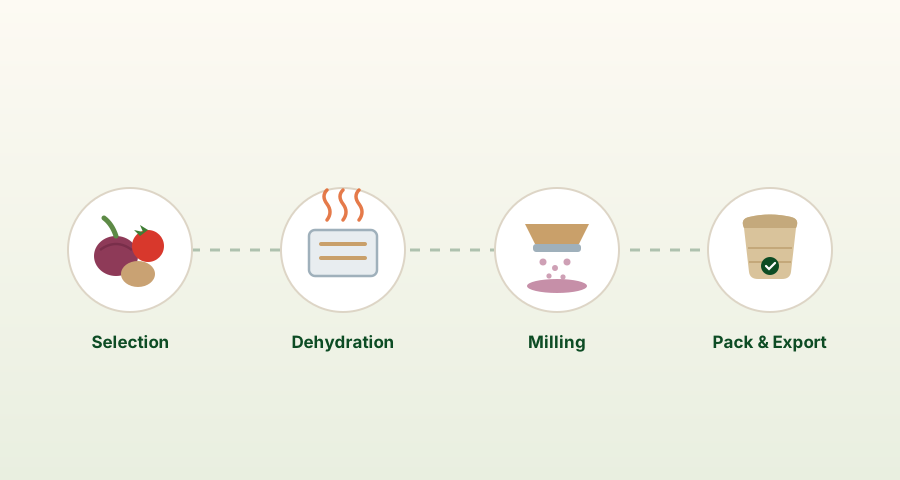
Four Stages
The path every production lot follows
- 01
Selection
Raw material is inspected at intake and unsound material rejected, because drying concentrates whatever entered the process — including its faults.
- 02
Dehydration
Temperature and airflow managed per product, removing moisture without scorching the volatile compounds that carry flavour and colour.
- 03
Milling & Sieving
Dried material is milled to the agreed mesh band and sieved for uniformity, then passed through magnetic separation and metal detection.
- 04
Testing & Packing
The lot is verified against the written specification, then sealed immediately into lined barrier packing and lot-marked.
Raw Material
The decision nothing downstream can undo
Dehydration is a concentration process. Remove the water and everything that remains — flavour, colour, sugars, and any defect — becomes several times more prominent. A slightly pale tomato produces a noticeably pale powder. A mild onion crop produces a mild powder that no amount of careful milling will sharpen.
This is why intake inspection is a genuine gate rather than a formality. Sprouted garlic cloves, greened potatoes, woody beetroot and unripe tomatoes are removed before processing, not sorted around afterwards.
It is also why we ask buyers about pungency, colour strength or acidity at enquiry stage. Those characteristics are largely set by variety and growing conditions, so the earlier we know your target profile, the better we can select raw material to hit it consistently rather than lot by lot.
Drying Temperature
Hotter is faster, and usually worse
There is a permanent commercial temptation in this industry to run dryers hot. Higher temperature means shorter cycles, more throughput and lower cost per kilogram. It also means damaged product, and the damage is not always obvious in the dry powder — it shows up in the customer's application.
What excess heat does
In garlic it scorches sugars and drives off aroma, leaving a bitter, toasted note in place of clean pungency. In tomato and beetroot it degrades the pigment, so the powder colours weakly and a formulator has to dose more to hit their target shade. In onion it flattens the characteristic sulphurous depth that is the entire reason for buying it.
What insufficient drying does
The opposite error is just as costly. Residual moisture above the target shortens shelf life, encourages caking in the bag and creates conditions for microbial growth during a long, warm transit. A powder that arrives as a solid block is a total loss regardless of how good it tasted at production.
The work is holding the middle: enough heat transfer to dry efficiently to the target moisture, controlled enough to leave the product intact. Each of our lines runs its own profile rather than sharing one.
Specification Parameters
What gets agreed, and what gets checked
The most common cause of disputes is ambiguity rather than bad faith. Fixing these in writing before production removes it.
| Parameter | Why it matters | How we handle it |
|---|---|---|
| Mesh size | Determines dispersion speed and visual speckle | Typically 60–100 mesh depending on product; custom bands milled to order |
| Moisture | Drives shelf life and caking behaviour | Typically below 5–7% by product; tighter limits on request |
| Colour | Critical where the powder is bought partly as a colourant | Assessed against an agreed reference for tomato and beetroot especially |
| Flavour character | The reason onion and garlic powder are bought at all | Checked by sensory assessment against the approved sample |
| Foreign matter | Non-negotiable for any food ingredient | Sieving, magnetic separation and metal detection as standard finishing steps |
| Lot identification | Makes post-delivery questions answerable | Every consignment carries a code tied to its production run |
Hygiene, Packing & Traceability
Protecting the lot after it leaves the mill
A finished powder is at its most vulnerable in the minutes after milling. Most of these products are hygroscopic — tomato and lemon powder markedly so — and will begin pulling moisture from the air immediately. Packing therefore happens promptly rather than at the end of a shift, into lined barrier packaging chosen for the product.
Packing is matched to the destination as well as the powder. A consignment going into a humid tropical warehouse needs a better moisture barrier than one going to a temperate climate, and for colour-sensitive products such as beetroot we recommend light-protective packing because pigment fades with prolonged light exposure.
Hygiene
Contact surfaces and equipment are cleaned between products, which matters more than usual here — residual garlic in a line will make itself known in the next product through it. Sieving, magnetic separation and metal detection are standard finishing steps on every lot.
Traceability
Every consignment carries a lot code tied to its production run and raw material sourcing. If a question arises after delivery, that code lets us trace it rather than speculate.
Independent verification
Pre-shipment samples from the actual production lot are available for every consignment, and buyers may appoint a third-party inspection agency before loading. A specification sheet accompanies quotations and shipments. Our export page covers documentation in more detail.
Common Questions
Quality and specifications
How is quality controlled during production?
By controlling the process rather than only inspecting the result. Raw material selection at intake, managed drying temperature, milling to a verified particle band and in-process checks determine finished quality far more than any final test can.
Can we inspect a lot before it ships?
Yes. Pre-shipment samples from the actual production lot are available for every consignment, and buyers are welcome to appoint a third-party inspection agency before loading.
What parameters can be customised?
Mesh size, moisture level, colour, flavour intensity and pack format are the usual variables. Share your existing specification sheet and we will confirm what we can meet.
Do you provide a specification sheet with each lot?
Yes. A specification sheet accompanies quotations and shipments, and each consignment carries a lot code tied to its production run for traceability.