Dehydrated Vegetable
Beetroot Flakes & Powder
Vivid natural crimson for foods, beverages and wellness
Introduction
About our beetroot flakes & powder
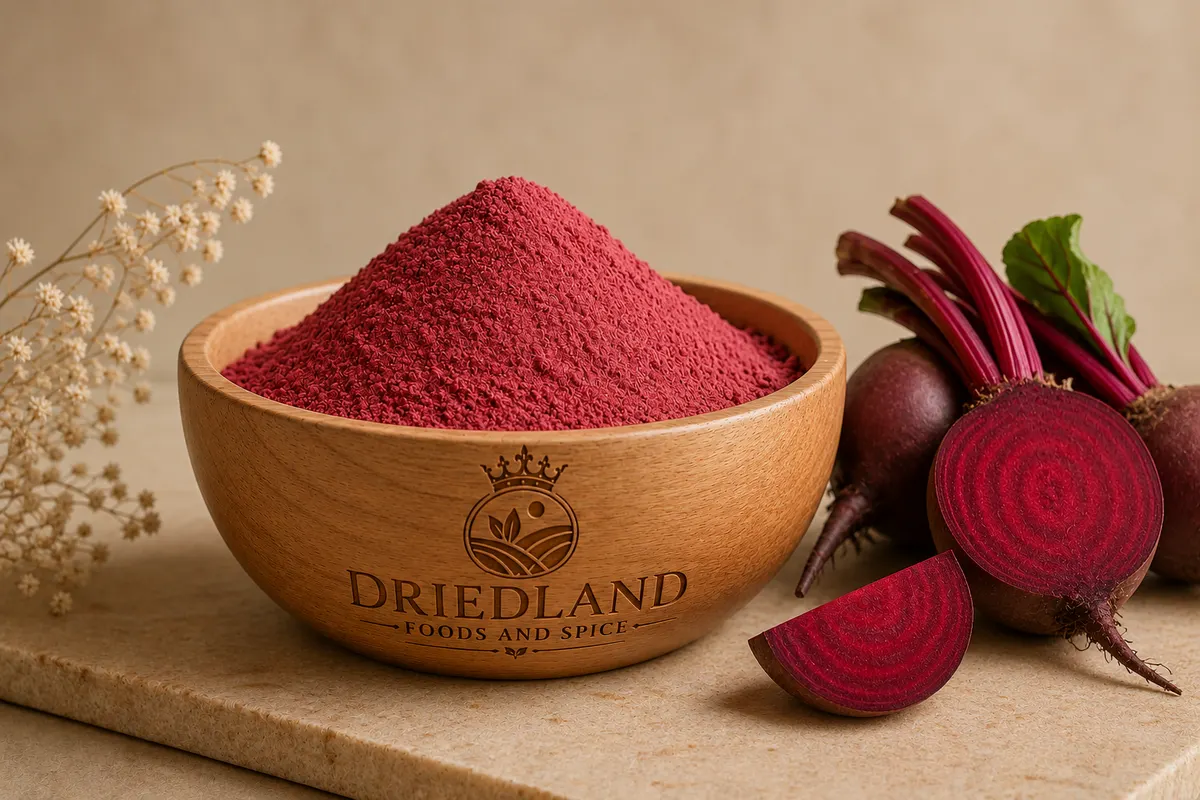
Beetroot sits at the intersection of two strong market currents: the shift from synthetic to natural food colours, and the growth of vegetable-based wellness products. Its intense crimson comes from betalains — the pigment family responsible for beetroot's famous staining power — which makes the dried product a striking, label-friendly colourant before its flavour even enters the conversation.
Driedland Foods and Spice manufactures beetroot in two forms from one pigment-protected drying process. The powder is the colouring and blending workhorse, dosed by the gram into icings, gummies, smoothie mixes and supplement formulations. The flakes serve where visible ruby pieces are the point — salad toppers, tea blends, soup garnishes and health mixes that want to show their ingredient rather than hint at it.
Working with betalain colour requires honesty about its behaviour: it is vivid in low-heat and cold applications — smoothie mixes, icings, yogurt coatings, gummies — but sensitive to prolonged high heat and strongly alkaline conditions, where it shifts toward brownish tones. Formulators who respect those boundaries get a brilliant pink-to-crimson range from a simple, recognisable vegetable ingredient.
Beetroot also carries a wellness story. Beets are naturally associated with dietary nitrates, which has made the powder a fixture in pre-workout blends, sports drinks and daily-greens formulations. We supply the ingredient and its typical composition data; health claims on finished products remain the brand owner's responsibility under their local regulations.
Product Family
The sub-products we supply in this line
Each beetroot flakes & powder sub-product below comes from one shared raw-material base, so flavour stays identical while the cut changes.
Beetroot Powder
The colouring and wellness workhorse, milled 60–80 mesh.
Beetroot Flakes
Ruby pieces for salad toppers, tea blends and premium health mixes.
Key Benefits
Why food manufacturers use beetroot flakes & powder
Vivid natural colour
Betalain pigments deliver pink-to-crimson shades from a single vegetable ingredient, supporting clean-label replacement of synthetic reds.
Powder and flakes from one base
Fine powder for colouring and blending; ruby flakes where visible beetroot pieces sell the product.
Pigment-protective drying
Managed temperature keeps the crimson bright instead of dulling it — the visible difference between careful and cheap drying.
Wellness market relevance
Beetroot's dietary-nitrate association makes it a sought-after base for sports nutrition and daily wellness blends.
Simple, honest labelling
Declares as beetroot — an ingredient shoppers recognise and trust, unlike E-number colourants.
Applications
Where this ingredient is used
Natural food colouring
Powder tints icings, creams, coatings, pasta and confectionery in pink-to-red shades under suitable conditions.
Sports nutrition and supplements
A core ingredient in pre-workout powders, nitrate-focused blends, capsules and daily-greens formulations.
Smoothie and beverage mixes
Colour, body and mild sweetness in smoothie powders, lattes and functional drink blends.
Bakery and confectionery
Natural tinting for cakes, macarons, cookies and gummies, best in lower-heat processes.
Salads, soups and garnishes
Flakes as visible ruby pieces in salad toppers, instant soups, and premium health mixes.
Herbal tea blends
Flakes contribute colour and earthy sweetness to infusion and wellness tea formats.
Industries Served
Sectors we supply this product to
Beetroot attracts the most nutrition-driven buyers in our range, with supplement and sports brands sitting alongside conventional colour users.
Specifications
Typical product specification
| Product forms | Flakes, powder |
|---|---|
| Colour | Deep pink to crimson red |
| Flavour | Earthy, mildly sweet, characteristic of beetroot |
| Typical cuts | Flakes 3–8 mm; powder 60–80 mesh |
| Moisture | Typically below 6%; as per buyer specification |
| Origin | India |
| Additives | None; 100% beetroot in standard grade |
| Documentation | Specification sheet provided with quotation |
Export Capability
What we offer international buyers
- Flakes and powder from one base
- Pigment-protective drying
- Light-protective packing options
- Bulk supply for industrial buyers
- Private label and OEM packing
- Samples from real production lots
- Export documentation support
- International shipping coordination
- Worldwide supply capability
Packaging, Storage & Shelf Life
Getting the product to you in the condition you expect
Packaging
- Barrier-lined cartons or laminated sacks, typically 20–25 kg, protecting colour and moisture
- Light-protective packing recommended and available for colour-critical buyers
- Retail pouches, jars and sachets under private label programmes
- Custom pack sizes, liners and labelling as per buyer requirement
Storage
Store sealed below 25 °C in a dry area shielded from light — betalain pigments fade with prolonged light and heat exposure. Rotate stock first-in, first-out and keep opened packs tightly closed.
Shelf Life
Typically 12–18 months from production in unopened, light-protective packing under recommended conditions. Colour retention guidance for your climate and application is provided on request.
Quality
How quality is controlled
Pigment strength, colour shade, cut size and moisture are verified on each lot against the agreed specification before shipment.
Only deep-red, sound beets enter production; pale, woody or damaged roots are rejected at intake because they dilute finished colour intensity.
Sieving and metal detection are standard, and buyers may request pre-shipment lot samples or third-party inspection.
Our quality process page explains the full approach across all products.
Manufacturing
How it is made
- Fresh beetroots are washed, trimmed and inspected, then cut for uniform drying.
- Prepared beet is dried under managed temperature and airflow chosen to protect betalain pigment from heat degradation.
- The dried base is milled and sieved into flake and powder fractions to the agreed bands.
- Both fractions pass metal detection before prompt sealing into barrier, light-protective packaging.
FAQs
Beetroot Flakes & Powder — frequently asked questions
Is beetroot heat-stable as a food colour?
Betalain pigment performs best in cold and low-heat applications. Prolonged high heat or alkaline conditions shift it toward brown tones, so we recommend trials in your process — icings, beverages and coatings show it at its best.
When should I choose flakes over powder?
Flakes when the beetroot should be seen — salad toppers, tea blends, garnishes, premium health mixes. Powder when it should disperse — colouring, smoothies, supplements and doughs. Both come from the same dried base.
Is the product 100% beetroot?
Yes — standard grade is pure dried beetroot with no carriers, colours or preservatives. If your application needs a carrier-standardised colour strength, we will discuss options transparently.
Can I use your beetroot in supplements?
It is widely used in nutraceutical blends. We provide specification data for the ingredient; regulatory compliance and any health claims on the finished supplement remain the brand owner's responsibility in their market.
How much powder does colouring take?
Typically under one percent for pale pink tints up to a few percent for deep crimson, depending on the base and process. Dosing trials with our samples give exact numbers for your formulation.
Does beetroot taste strongly of beets?
At colouring dosages the earthy note is mild and often imperceptible in flavoured products. At wellness-blend dosages it comes through and usually pairs well with fruit or cocoa flavours.
Related Products