Dehydrated Onion
White Onion Flakes & Powder
The dehydration-grade classic — sorted flakes to fine powder
Introduction
About our white onion flakes & powder
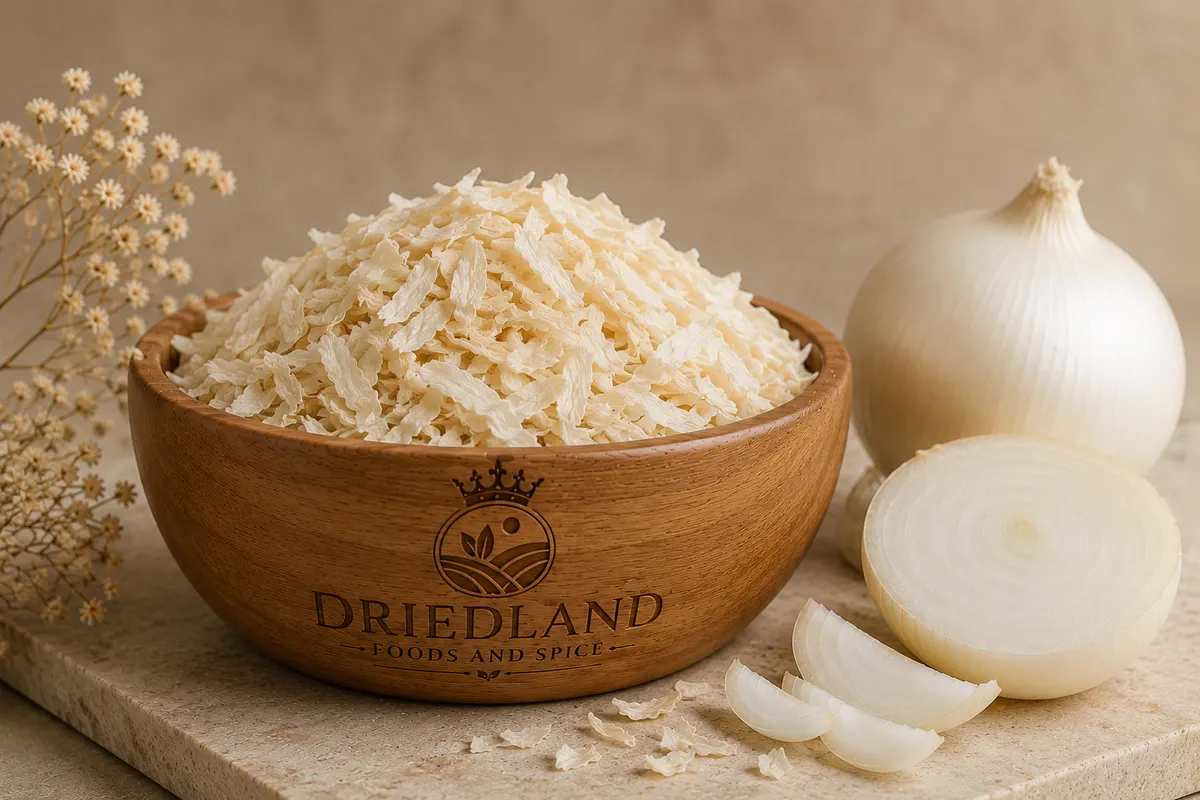
White onion is the workhorse of the dehydration industry, and it earned that position on chemistry rather than habit. Dehydration-grade white varieties carry high dry-matter solids and strong pungency, so a kilogram of raw onion yields more finished product with more flavour than table varieties manage — and the near-white colour survives drying into a clean, pale flake that disappears visually into any recipe.
Driedland Foods and Spice manufactures dehydrated white onion across the full cut range: kibbled flakes, chopped, minced, granules and fine powder, milled from the same dried base and separated by particle size. Buyers who blend seasonings usually take granules or powder; soup, stuffing and ready-meal manufacturers usually want the visible flake.
The sorted-versus-unsorted distinction matters commercially and we quote both. Unsorted flakes come off the drying line as they are, including the naturally caramelised and edge-toasted pieces that are inevitable in any dryer. Sorted flakes then pass colour sorting and hand inspection to remove those darker pieces, giving a visibly cleaner, more uniform flake. Sorted grade suits retail and visible applications; unsorted is the economical choice where the flake will be cooked into a sauce or ground down anyway.
Because the base material is identical, a buyer can run sorted flakes in their retail line and unsorted in their industrial line without any flavour mismatch between the two — a small detail that simplifies quality control more than most buyers expect.
Product Family
The sub-products we supply in this line
Each white onion flakes & powder sub-product below comes from one shared raw-material base, so flavour stays identical while the cut changes.
White Onion Flakes — Sorted
Colour-sorted export grade with the darker pieces removed — the flake for retail packs and visible applications.
White Onion Flakes — Unsorted
Straight off the drying line including naturally toasted pieces — the economical grade for cooking and grinding.
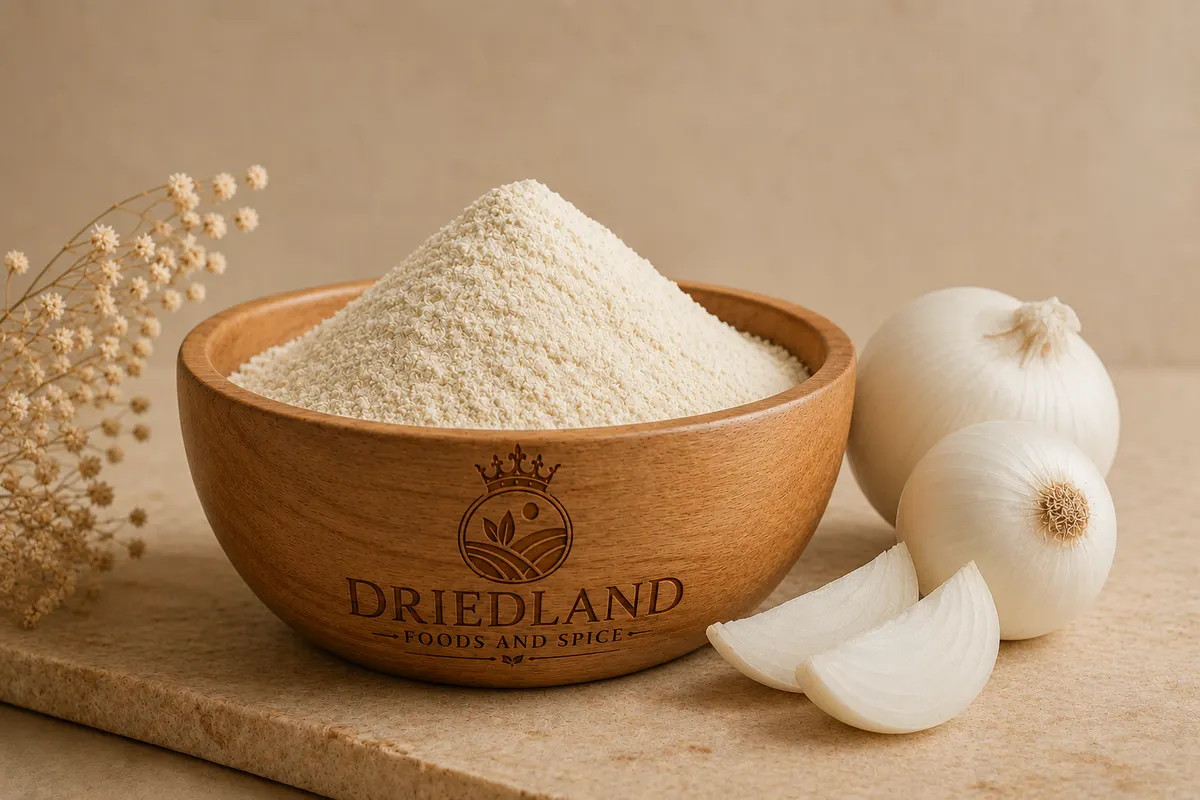
White Onion Powder
Fine-milled from the same dried base for blends, sauces and seasonings.
Key Benefits
Why food manufacturers use white onion flakes & powder
High-solids dehydration varieties
Grown from white onion types selected for dry matter and pungency, which is what makes the finished flake taste like onion rather than like paper.
Sorted and unsorted grades
Colour-sorted export grade for visible applications, unsorted industrial grade where economy matters — same raw material, honestly separated.
Colour-neutral in application
The near-white flake and powder vanish into pale sauces, dips, mayonnaise systems and bakery fillings without tinting them.
Full cut range from one base
Kibbled, chopped, minced, granules and powder milled to consistent particle bands, so every texture need is covered by one supplier.
Strong rehydration behaviour
Flakes rehydrate to tender onion pieces in minutes, carrying cooked-onion flavour into soups and ready meals without fresh handling.
Applications
Where this ingredient is used
Soup and instant noodle mixes
Kibbled and chopped cuts rehydrate visibly in dry soups, cup noodles and instant meal formats.
Seasoning blends
Granules and powder form the savoury backbone of spice blends, rubs and table seasonings.
Stuffings and bakery toppings
Flakes fold into stuffing mixes, savoury breads, buns, crackers and bagel-style toppings.
Sauces, dips and dressings
Powder disperses cleanly into pale emulsions where fresh onion would split or discolour them.
Meat and snack processing
Minced and granulated cuts distribute evenly through sausage blends, patties and extruded snack seasonings.
Food service kitchens
A stable pantry replacement for daily chopping in hotels, caterers and central kitchens.
Industries Served
Sectors we supply this product to
White onion moves in larger volume than anything else we make, so buyers here range from seasoning houses to the largest soup and snack manufacturers.
Specifications
Typical product specification
| Product forms | Kibbled/flakes (sorted or unsorted), chopped, minced, granules, powder |
|---|---|
| Colour | Creamy white to pale buff |
| Flavour | Pungent, savoury, characteristic of white onion |
| Typical cuts | Flakes 8–20 mm; minced 1–3 mm; granules 0.5–1 mm; powder 80–100 mesh |
| Moisture | Typically below 6–7%; as per buyer specification |
| Sorting | Colour-sorted export grade or unsorted industrial grade |
| Origin | India |
| Documentation | Specification sheet provided with quotation |
Export Capability
What we offer international buyers
- Sorted and unsorted grades
- Full cut range from one base
- Bulk supply for industrial buyers
- Custom cut and mesh specifications
- Private label and OEM packing
- Samples from real production lots
- Export documentation support
- International shipping coordination
- Worldwide supply capability
Packaging, Storage & Shelf Life
Getting the product to you in the condition you expect
Packaging
- Multi-wall paper bags or laminated woven sacks with food-grade liner, typically 20–25 kg
- Cartons with inner liner for flakes where crush protection matters in transit
- Retail jars and pouches under private label programmes
- Custom pack sizes, liners and labelling as per buyer requirement
Storage
Store sealed in a cool, dry, odour-free warehouse below 25 °C. Flakes are fragile as well as hygroscopic — stack cartons rather than throwing sacks, and keep opened packs tightly closed to prevent moisture pickup and breakage into fines.
Shelf Life
Typically 12–24 months from production in unopened original packing under recommended conditions. Flakes kept in crushed, opened bags lose their visual grade long before their flavour.
Quality
How quality is controlled
Every lot is checked for colour, cut size, moisture and flavour character against the agreed specification before dispatch.
Sorted grade passes colour sorting and inspection to remove caramelised and edge-toasted pieces; the sorting standard is agreed with the buyer, not left to interpretation.
Sieving, magnetic separation and metal detection are standard finishing steps, and pre-shipment samples from the actual lot are available.
Our quality process page explains the full approach across all products.
Manufacturing
How it is made
- Dehydration-grade white onions are topped, peeled and washed, then sliced for uniform drying.
- Slices are dried under controlled temperature and airflow to preserve pungency while reaching stable moisture.
- The dried base is cut and sieved into kibbled, chopped, minced, granule and powder fractions.
- Sorted grades pass colour sorting; all grades pass magnetic separation and metal detection before being sealed into lined export packing.
FAQs
White Onion Flakes & Powder — frequently asked questions
What is the difference between sorted and unsorted flakes?
Unsorted flakes come straight off the dryer and include the naturally darker, edge-toasted pieces. Sorted flakes pass colour sorting and inspection to remove them, giving a cleaner, more uniform appearance. Sorted suits retail and visible use; unsorted is the economical industrial grade.
Which cut should I choose for my application?
Visible applications — soups, stuffings, toppings — usually want kibbled or chopped. Blends and rubs usually want granules or powder for even distribution. If you are unsure, describe the finished product and we will recommend and sample a cut.
Why white onion rather than red or pink?
White dehydration varieties carry the highest solids and pungency, and the pale colour stays neutral in application. Where a buyer wants colour character instead, see our red onion and pink onion lines — the same cut range applies.
Do flakes and powder taste the same?
They come from the same dried base, so the flavour chemistry is identical. The difference is release: powder disperses instantly, while flakes rehydrate into soft pieces and release flavour as they cook.
How do you stop flakes arriving as broken fines?
Flakes are packed in lined cartons or carefully handled sacks, and containers are loaded to avoid crushing. Some fines are inevitable in any dried flake; the tolerance is agreed in the specification rather than discovered on arrival.
Can you supply both retail and industrial grades together?
Yes — sorted flakes for your retail packs and unsorted for your industrial line can ship in the same container, and because the base material is identical there is no flavour mismatch between them.
Related Products